
Resources
Selecting a Site
Selecting a Site
Selecting a site with the right size and condition is the foundation of a successful traffic garden installation, whether called a safety town, safety city, or traffic playground. Traffic Garden Designs helps assess your space so the layout fits well, functions properly, and supports everyday use. One of the most important lessons we have learned is that careful site selection should happen before any further planning proceeds.

Start Here:
Choosing & Evaluating a Site
A thoughtful site selection and visit process will save time, reduce costs, and lead to a better result. A great traffic garden starts with a mostly-flat, well-located site that people can easily access. If you already have a site, assess whether it offers enough space for one of the twelve layouts (see instructions below). If you are still searching, look for underused paved areas and ask about overlooked or forgotten spaces. Aerial imagery can help you spot a clean rectangle of asphalt, like a former classroom trailer pad or an unused tennis court. Think about how people will find and enter the space, and how it connects to nearby amenities. A well-chosen location feels inviting and easy to use from day one, with extra appeal when it sits alongside a playground.
Visiting the site in person is essential to fully understand its conditions. Focus on practical details that will affect installation and long-term performance. Check the pavement carefully. Check the setting and note any conflicts or hazards. These early observations help avoid surprises and set the project up for a smooth, successful installation. Look for opportunities to create a sense of place and ensure that the traffic garden feels like its own small destination.

The Best Sites Are Hiding in Plain Sight
Many of the best potential sites are already part of everyday spaces, they just need to be viewed differently. Underused courts, extra parking areas, wide schoolyards, and overlooked paved corners can often be transformed into engaging places for riding, learning, and play with far less effort than people expect.
Our standard layouts are designed around common site types found in schools, parks, apartment communities, and other public spaces. Particularly strong candidates include:
☑ Former or underused tennis courts
☑ Basketball courts and multi-use courts
☑ Underused parking areas that can be repurposed
☑ Schoolyards and paved play areas
☑ Former classroom trailer pads
☑ Parks and recreation facilities
☑ Apartment and community common areas
☑ Other paved spaces with sound pavement and minimal slope
If you're unsure whether a site will work, we're happy to evaluate it.
Ideal Site Geometry
Standard layouts work best on sites that offer clear, consistent geometry and enough space to establish a legible street network. Tennis courts, basketball courts, and similar rectangular paved areas are often ideal, as their defined edges make it easier to position key elements like intersections, roundabouts, and travel lanes. Parking lots and schoolyards can also work well, especially when there is a section that can be dedicated to the traffic garden without ongoing conflicts.
Spaces with straightforward dimensions allow layouts to be scaled and adjusted with minimal complexity, making them easier for contractors to set out accurately in the field. The more the site geometry supports clear references like parallel lines, right angles, and consistent offsets, the more successful the final result will be.
The Non-Negotiables
A successful traffic garden site will usually share a few important core conditions:
☑ Sound pavement surface suitable for coatings and striping
☑ Adequate space for the traffic garden layout (plus the green buffer)
☑ Almost flat with adequate drainage
☑ Safe and convenient access for people on foot and rolling
☑ No routine motor vehicle traffic crossing site
☑ Accessibility and visibility
☑ Seamless entry and exit
Surface Conditions: What’s Acceptable (and What’s Fixable)
Most paved, relatively flat surfaces in a good spot can support a traffic garden, but pavement condition will directly affect the quality, durability, and long-term performance of the installation. Minor wear and surface imperfections are common and can be addressed through routine repair work before installation.
The key is distinguishing between cosmetic issues that are relatively straightforward and inexpensive to address and more serious structural problems that may affect the viability of the site. An early assessment can quickly determine whether a site is ready for installation, can be made suitable through moderate repairs, or will require more significant improvements.
Ready for Transformation
Minor surface cracking
Light surface wear and fading
Older but sound asphalt
Existing painted markings
Slight surface roughness
Previously used recreation courts
Can Work With Preparation
Moderate cracking requiring crack fill
Small isolated potholes
Rough or weathered asphalt surfaces
Localized pavement patching
Minor drainage adjustments
Posts needing removal and patching
May Require Major Improvements
Alligatored cracking or crumbling asphalt
Severe drainage problems or flooding
Major heaving or large elevation changes
Extensive disintegrating asphalt or crumbling edges
Steep slopes creating unsafe riding conditions
Persistent standing water issues
Access, Visibility, Safety & Location Matter
A traffic garden can be beautifully designed, but its success often depends on where it is located. Sites that are easy to find, easy to reach, and visible to nearby users tend to attract more activity and feel safer. Good locations also minimize conflicts with vehicles and other uses when accessing.
When evaluating a potential site, consider the following:
☑ Easy for children and families on foot and rolling to reach
☑ Visible from nearby spots like buildings, playgrounds, or streets
☑ Nearby spaces for supervision and observation
☑ Clear, intuitive, and accessible entry and exit points
☑ Safe entrance location along a low-traffic street
☑ Minimal conflicts with parking, deliveries, or service vehicles
☑ Likely to attract regular use rather than being hidden or isolated
Can This Site Work?
A quick way to assess a potential site is to ask a few practical questions. Is there enough continuous paved area to create a clear layout without squeezing elements too tightly? Is the surface in reasonable condition, or can it be made workable with basic repairs? Can users enter and exit safely without crossing active vehicle areas? If the answer to these questions is yes, the site is likely a strong candidate.
Next, consider how the space will function day to day. Is it visible and easy to supervise? Will it conflict with existing uses like parking or deliveries? Can the layout be set out clearly using simple geometry that installers can follow in the field? Sites that support straightforward layout and consistent use tend to perform best over time.
Finally, think about the overall feel of the space. Does it have the potential to feel like a defined, inviting environment rather than leftover pavement? Can edges, access points, and key features be arranged to create a sense of place? If the site meets these basic tests, it is very likely to support a successful and well-used traffic garden.


Matching Your Site to a Layout
Our 12 layouts are designed to fit many common public spaces so matching a site is usually straightforward but feel free to contact us if you would like assistance.
Step 1: Measure Your Available Space
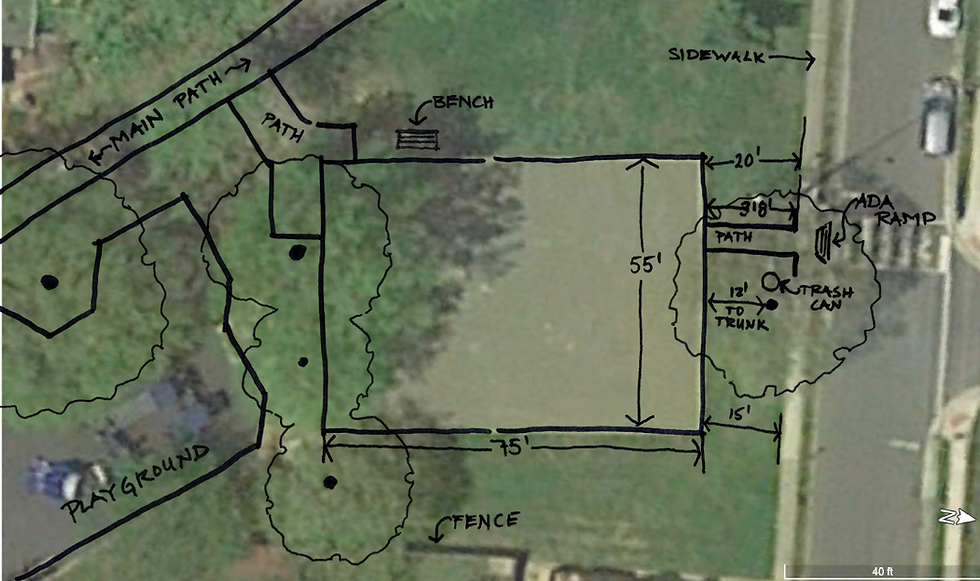
Start by confirming the site edges and dimensions. An aerial image or hand drawn diagram and a few length and width measurements are usually sufficient.
-
Outline the proposed site on the aerial
-
Note pole, tree, or storm drain locations
-
Measure the usable paved area
-
Double check your measurements!
Step 2: Match Your Site to Plan Dimensions
Review the plan sets and identify the option(s) that most closely matches your site's size and shape on the aerial. Check the following:
-
Layout fits easily (if not see Step 3)
-
Key features align with the site orientation
-
There are no conflicts with existing obstacles
Step 3: Fine-Tune the Fit
After purchase, plan sets can typically be adjusted to better fit your site. Common adapations include:
-
Increasing street lengths to better match site
-
Adjusting layout width or length by a few feet
-
Shifting layout within the site
-
Minor adjustments for fixed items like poles
-
Adjusting buffer widths around edges if needed